
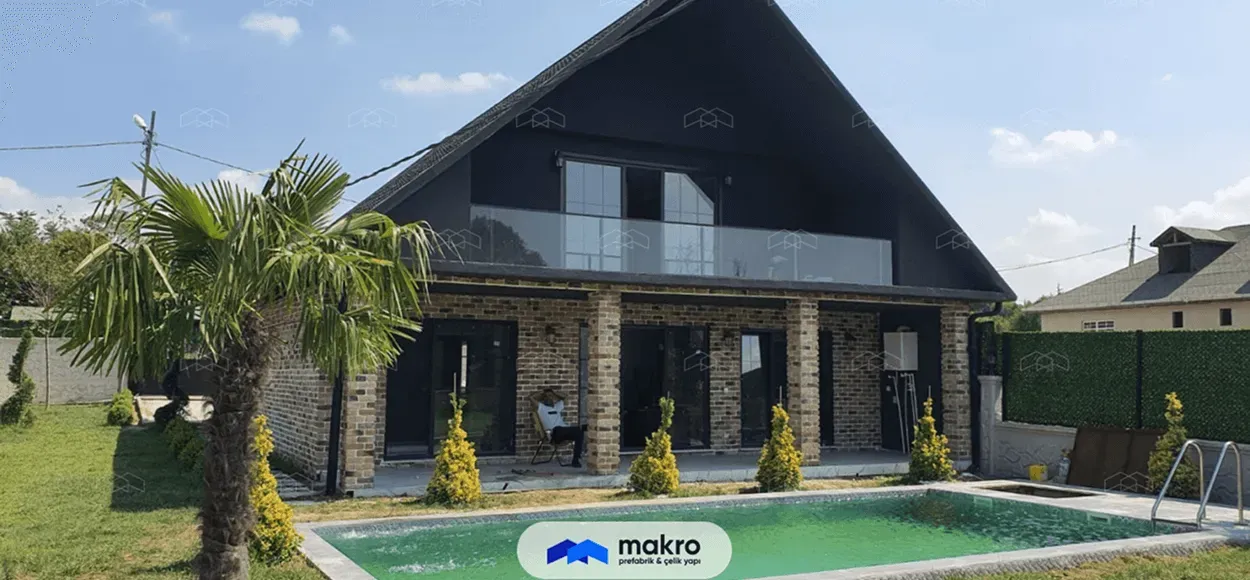
Recently, these structures produced in factories and placed in villages have become quite popular. Indeed, these structures can be used in many different areas. Especially in villages, these house models, which are an affordable option, are preferred in various sizes. However, in our country, there are certain legal conditions for the construction of these structures. We have researched the legal factors and written about this topic in our article.
Many different building models are used in various parts of our country. Since the factory-produced building models are designed aesthetically, they are indistinguishable from other houses. From this perspective, prefabricated house prices are also affordable, so these structures are very popular in the rural areas of our country. As a matter of fact, these structures stand out as an affordable option for villages.
Due to the advantages they offer and their affordable price, these structures are widely preferred in our villages. Besides being affordable, these house models are quite durable and long-lasting. From this point of view, these structures can be used in many different parts of our country. Especially in villages, these structures are highly preferred because of their durability and low cost.
For these structures to be used in villages, certain legal permissions must be obtained. Within these permissions, the size and design of the house you purchase can be customized. Thus, you can buy a house that complies with both the laws and your preferences. We have also detailed some laws you need to pay attention to in the next section.
Many different structures are used in various parts of our country, in different sizes and designs. From this perspective, these factory-produced structures are especially widely used in villages. However, according to our country's laws, regardless of whether a structure is reinforced concrete or prefabricated, a building registration permit must be obtained. Therefore, before constructing a house, you need to pay attention to the following points.
First of all, you need to have a plot of land to build a house. When purchasing land, one of the most important considerations is the nature of the land. In other words, the land must be classified as land. If the area you purchase is classified as a field, you cannot build a house on it. As a matter of fact, fields are protected by the Ministry of Agriculture and Forestry. Due to this protection, houses cannot be built on fields. Only agricultural activities can be carried out on fields.
Not 100% of the land you purchase can be built upon. That is, a part of the land can be used for construction. This way, you can use the remaining part of your land as a garden or for landscaping. In fact, this situation is regulated within the scope of the law. By setting aside this area, space remains for parking and drainage. Thus, the house you build can also be more durable.
Once there are no issues with the land, a building registration permit must be obtained through the municipalities and the Land Registry Directorate. Some fees and official procedures are required for this. Afterwards, you can learn how large a structure you can build with the building registration permit. After the construction is completed, a occupancy permit must be obtained. Once the occupancy permit is granted, you can benefit from water, electricity, and natural gas services.
All houses in our country are built and produced within the scope of certain legal permissions. These laws help to enclose neighborhoods and create more livable areas. Within this scope, two-story prefabricated houses are used to create more livable spaces. From this perspective, laws are in place for all of us, and we are required to comply with them. This also applies when building a house.
If you wonder what happens if you do not comply with the laws when building a house, the simplest answer is that the house you built may face risk of demolition by municipal teams. Even if your house is not demolished, you cannot benefit from services such as electricity, water, and natural gas. However, you can generate these services through solar panels and rain harvesting. Nonetheless, your house will not be legal, and you will only pay land tax within the scope of taxes.
Illegal structures can be detected through cadastral flights conducted once a year. Thanks to these flights, the legal status of all structures in our country can be reported to the municipalities. There is no way to escape this situation. However, building a legal house is quite easy. By paying the necessary fees and submitting your official documents, you can obtain your legal permits. You can also purchase and use one of these legally compliant structures immediately.