The main question in the minds of families with safety concerns is quite clear. Can a house built with a steel system truly provide a safer structure in risks such as fire or flood? It is stated that steel is a fire-resistant material, that steel frames are reinforced with fire-resistant coatings, and that it establishes a structural logic that reduces fire risk. The single-story steel house page clearly states that stone wool is known for its high-temperature resistance and fire durability. The sense of security is not only derived from the skeleton but also from the wall and roof layers. When stone wool, drywall cladding, steel frame, and correct detail solutions are considered together, a more controlled behavior during a fire is achieved. The part that reassures people in daily life begins right here. While the fear of flame spread is higher in a wooden structure, a steel-supported system provides a more composed foundation. Of course, electrical installations, stove usage, chimney details, and interior finishes also play a significant role. However, the fact that the load-bearing system provides a safer starting point regarding fire is a valuable advantage for families.
The most important point on the fire side is the behavior of the skeleton material. It is explained that steel is resistant to fire, that steel frames are strengthened with fire-resistant coatings, and that it establishes a structure logic that reduces fire risk. The single-story steel house page also explicitly states that stone wool is known for its high-temperature resistance and fire durability. The feeling of security is also supported by wall and roof layers, not just the skeleton. When considering stone wool, drywall cladding, steel frame, and correct detail solutions together, a more controlled behavior during a fire is achieved. The part that comforts people in everyday life starts exactly here. While the spread of flames is more perceived in a wooden-based structure, a steel-supported system offers a more composed foundation. Naturally, electrical wiring, stove use, chimney details, and interior finishes are also very important. But the fact that the load-bearing system creates a safer starting point regarding fire is a valuable addition for families.
When it comes to floods, the first thing that comes to mind is the contact of water with the structure. It is stated that in the examined steel house contents, steel provides greater durability in disasters like floods compared to traditional building materials. Another page mentions that it is more resistant to moisture than wooden structures, making it a stronger option in natural disasters such as earthquakes and floods. The advantage on the material side is based on the lower risk of decay in areas that come into contact with water. However, flood resistance is not explained solely by the material. The same source group emphasizes the importance of a flat concrete floor, development efforts to prevent displacement in strong winds, and liquid insulation. Using 80 mm EPS foam in interior and exterior walls, fiberglass in the ceiling, galvanized material and shingle roofing, and PVC windows strengthen the insulation of heat, sound, and liquids. Proper drainage around the structure, elevation differences, and well-planned drainage solutions are also among the factors that determine real performance. In short, steel houses offer a more advantageous foundation in flood risk, but if the land application is weak, expectations decrease.
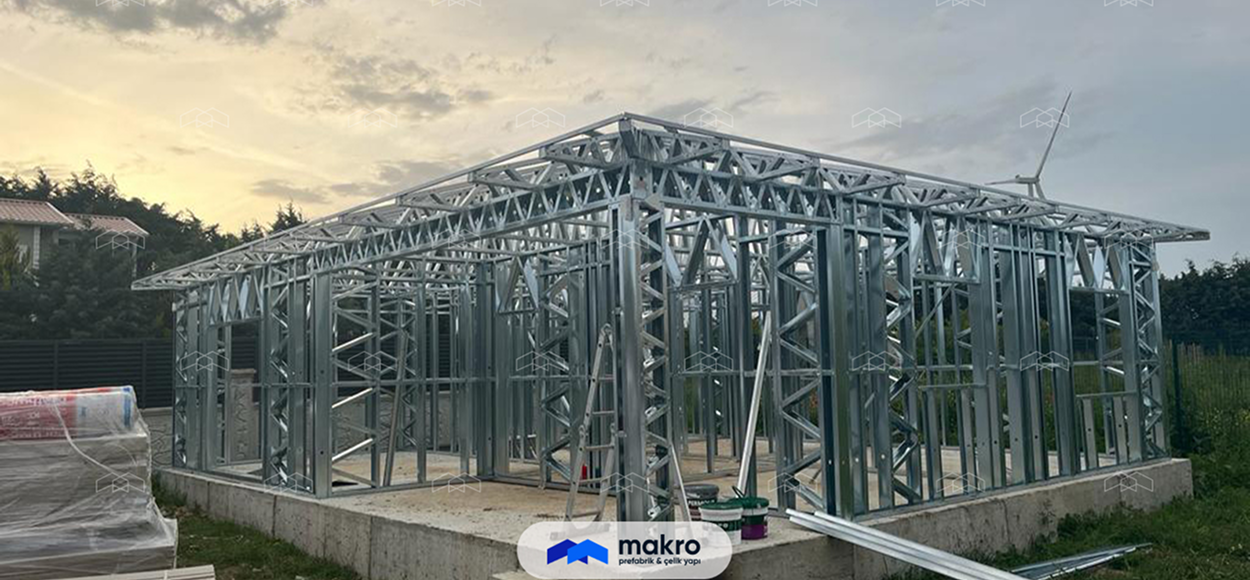
The strongest aspect of steel systems in disaster resistance is their ability to establish a lightweight and flexible load-bearing arrangement. Resistance against earthquakes, strong winds, and natural disasters is seen to be related to the strength and flexibility of steel. When joints, columns, and beams are prepared with controlled manufacturing logic, the overall balance of the structure becomes more reassuring. The reduction of errors in factory production also plays an important role. Insulation layers also indirectly affect disaster resistance. Stone wool stands out in terms of fire resistance and sound insulation. EPS foam is described as a key component of the system with its low thermal conductivity, high insulation capacity, and low water absorption characteristic mentioned in some pages. The system, combined with double-glazed PVC windows, metal tile or shingle roof coverings, and interior wall layers, contributes to a more balanced operation of the house.
Two-story plans are frequently discussed for large families or those seeking more usage area on a small plot. Two-story steel house models are emphasized in technical explanations, stating that these structures carry less fire risk compared to wooden houses, are considered more resistant to natural disasters, and that correct design and material quality are decisive. Despite the upper floor usage, the ability of the lightweight load-bearing system to absorb stresses is conveyed as an important advantage against earthquakes and winds. When the floor plan, staircase placement, exterior cladding, wall thickness, and insulation layer are considered together, a more reliable decision can be made. The feeling of security in family life is not only derived from spacious square meters but also from well-designed details.
When discussing disaster resistance, promises on paper alone are not sufficient.
How the columns, beams, and joint points are resolved must be learned. Factory production and controlled assembly increase the overall safety of the structure.
Details such as stone wool or EPS in walls, stone wool in the roof, double-glazed PVC in windows make a difference in fire, heat, and water management.
One of the most critical points in flood risk is the elevation of the land and the removal of water from the structure. Solid concrete foundation and good site landscaping provide great comfort.
Components such as fiberboard, fiber cement, plasterboard layers, metal tile, or shingle roofing directly affect the overall behavior of the house.
Whether a house provides security is understood not only from a single sentence in the brochure but also from how the details are interconnected. A structure that can stay calm in fire, flood, or harsh weather conditions is formed exactly this way.
It is clearly stated that they can show higher resistance in disasters such as floods and earthquakes, and that insulation is reinforced with layers like stone wool and EPS. Steel house prices should be evaluated not only considering costs but also longevity, ease of maintenance, energy efficiency, and a sense of security. The issue is not just shelter but creating a living space that provides inner peace when entering the home. Both two-story steel house plans and single-story solutions, when properly designed, are among the strong options that make families feel safer.