
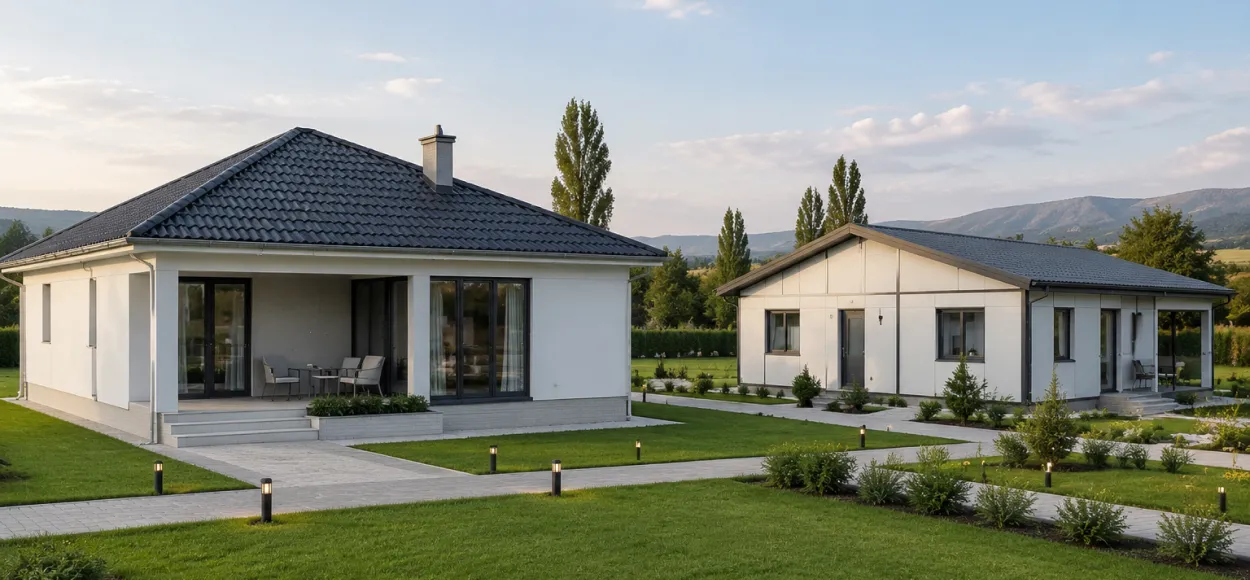
Steel house and prefabricated house are two construction options frequently compared due to their quick installation, planned production, and controlled cost advantages. However, giving a one-word answer to the question “which one is more durable?” is not correct. Because the lifespan of a structure is determined not only by the system used. Material quality, project details, production standards, ground preparation, climate conditions, installation quality, and regular maintenance directly affect the service life of the building.
Generally, steel houses offer a strong option in terms of durability, stability, and long-term use because their load-bearing systems use lightweight steel structural elements. Prefabricated houses provide advantages of quick assembly and practical use with factory-produced panels and modular construction systems. With proper planning and the use of quality materials, both construction systems can be used safely for many years.
The most important factor determining the lifespan of a steel house is the quality of the load-bearing system. The strength of the profiles used in lightweight steel structural systems, connection details, corrosion protection level, and assembly practices are critical for long durability. When the steel system is properly designed, exterior cladding and roof details are appropriately selected, and maintenance processes are not neglected, it can provide long-term efficient use.
In steel houses, moisture, waterproofing, and corrosion control are especially important. If the building is located in an area with heavy rainfall, near the sea, or has high humidity, protective details need to be planned more carefully. When the roof, gutters, exterior cladding, window joints, and foundation connections are regularly checked, the building’s lifespan is better preserved. You can visit the link for Steel house prices.
The lifespan of a prefabricated house is also largely related to production quality, panel structure, assembly practices, and maintenance routines. Wall panels, roof system, connection elements, exterior cladding, insulation details, and ground connections should be evaluated together. Prefabricated houses produced with quality materials and installed on appropriate ground can be used for a long time with regular maintenance.
The most important issues to pay attention to in prefabricated houses are exterior maintenance, roof inspection, water drainage, and insulation performance. Rainwater accumulation, poor ground preparation, incorrect assembly, or lack of maintenance can reduce the quality of use over time. Therefore, when choosing a prefabricated house, not only the model and square footage but also the manufacturer’s experience, technical details, and installation process should be considered. You can also visit the link for prefabricated house prices.
In terms of durability, steel houses are considered advantageous in many projects due to their load-bearing system strength and engineering flexibility. Especially in projects requiring long-term use, larger spans, multi-story plans, or higher strength expectations, steel construction systems can stand out. Lightweight steel systems offer a solid infrastructure with correct static calculations and proper application.
Prefabricated houses, on the other hand, are a strong alternative for projects requiring practical, economical, and quick installation. Single-story use, holiday homes, garden houses, temporary or seasonal use needs can be more suitably met with prefabricated houses. Therefore, when evaluating durability, it is important to consider where, how long, and for what purpose the building will be used.
Regardless of whether it is a steel house or a prefabricated house, the area where the building will be constructed plays a decisive role in its longevity. Without proper ground preparation, issues such as settlement, moisture, water pooling, or connection problems may occur over time. Therefore, the foundation, ground concrete, drainage, and infrastructure connections should be properly planned independently of the building system.
Climate conditions also affect the lifespan. In regions with heavy snowfall, roof slope and load calculations should be carefully considered; in windy areas, connection details; in hot regions, insulation and solar effects; and in humid regions, exterior cladding and waterproofing should be evaluated more carefully. For a long-lasting structure, the model selection must be made according to regional conditions.
Although steel houses and prefabricated houses are factory-produced systems, they should not be considered completely maintenance-free. Roof coverings, gutters, exterior surfaces, door and window joints, plumbing penetrations, and insulation details should be checked periodically. Small maintenance tasks not performed on time can lead to larger repair costs.
Especially in houses left unused for a long time, ventilation, moisture control, plumbing, and electrical systems should be inspected. Even if the building is not in use, it continues to be exposed to external environmental conditions. Therefore, regular maintenance is one of the fundamental factors that extend the service life of both steel and prefabricated houses.
If a longer lifespan, permanent residence, multi-story building plan, or a stronger load-bearing system is desired, a steel house may be a more advantageous option. Conversely, if quick installation, economical solution, single-story use, and practical living space are prioritized, a prefabricated house can be the right choice.
What matters here is not just comparing the two systems with the question “which is more durable?” but evaluating according to the project’s needs. When proper ground, correct design, quality production, and regular maintenance are provided, both construction systems can be used safely for a long time. Makro Prefabrik supports users in planning their projects more consciously with prefabricated and steel construction solutions tailored to different needs.