
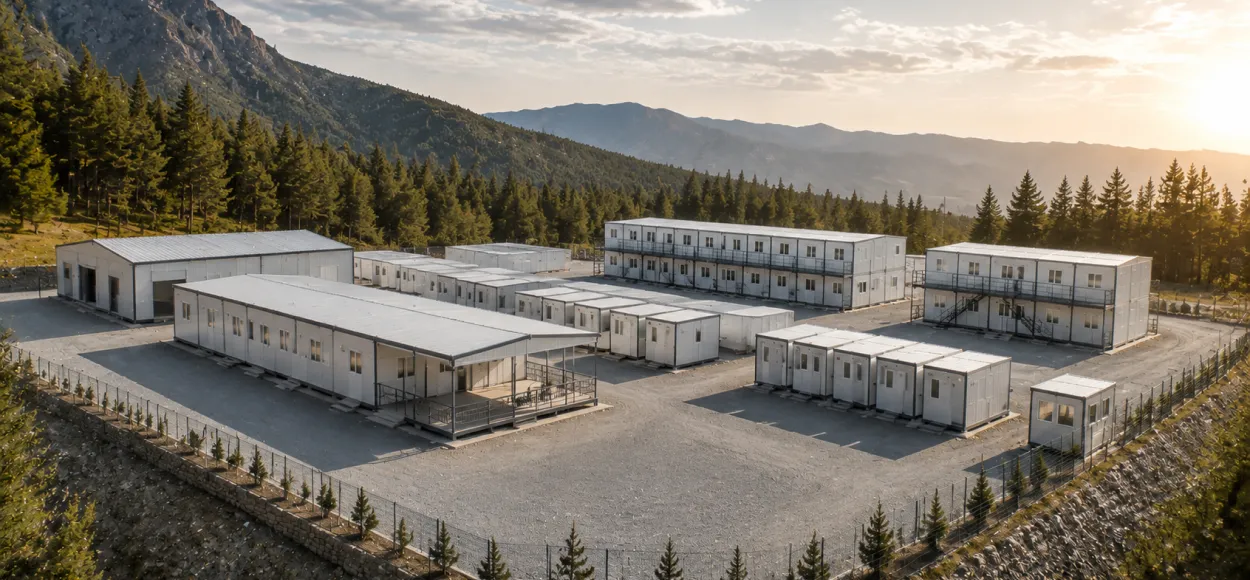
On-site modular system approach for producing units such as offices, dormitories, dining halls, WC showers, storage, security cabins, infirmaries, and social areas with pre-planned modules that can be quickly assembled on site. In this system, the structures needed are evaluated together according to the flow of the project area, rather than individually.
This modular construction approach offers significant advantages especially in construction, energy, infrastructure, mining, industry, and large-scale field projects. Because in these projects, accommodation for personnel, work areas, hygiene units, security points, and support structures need to be organized quickly. Properly planned modular site structures accelerate site setup and help ensure smoother daily operations.
Time is one of the most critical cost factors in construction site projects. Prefabricated site structures prepared with a modular system are produced in a factory environment, making the on-site installation process more controlled. Since most of the structural elements are produced in advance, the need for prolonged construction activities on site decreases.
This situation is especially advantageous at the beginning of a project. When prefabricated offices, worker dormitories, dining halls, and WC shower areas can be quickly put into use, site organization can start earlier. The Turkish Prefabricated Buildings Association states that the controlled environment production of structural elements in prefabrication requires less labor on site and makes the production process more verifiable.
One of the key advantages of modular site structures is that the camp layout can be prepared more systematically. Units such as dormitories, dining halls, offices, WC showers, and storage are not considered independently. Each module is positioned considering personnel movement, vehicle traffic, security points, infrastructure connections, and emergency access.
This approach reduces confusion on site. Where personnel will stay, where they will eat, which route they will take to reach the work area, and how they will access hygiene units can be planned from the start. The Ministry of Labor and Social Security’s safety construction guides emphasize that health and safety plans should be tailored to the project, and social facilities and site rules should be incorporated into the plan.
The number of personnel on a site project may not remain the same throughout the project. The site, which starts with a small team, can become larger over time. The modular system adapts more easily to these changes. Additional dormitories, new office units, extra WC shower units, or storage modules can be added to the plan if needed.
Similarly, when the project shrinks, some modules can be repurposed in different areas. This flexibility is especially important for projects with seasonal intensity. Compared to standard fixed structures, modular site structures can respond more practically to changing site needs.
Site structures produced with a modular system can be reused in different projects when suitable technical conditions are provided. This feature is particularly advantageous for construction, infrastructure, and energy companies that operate in different sites continuously. A site office, dormitory, or support unit used in one project can be reassessed and used at another location after the project is completed.
This portability is also important from a long-term investment perspective. Instead of building a new fixed structure for each project, using modular structures across different sites can simplify overall cost management. However, connection details, current condition, transportation conditions, and ground preparation at the new site must be checked before moving the structures.
Using a modular system in site structures helps make costs more predictable. When production, transportation, assembly, infrastructure connections, and site layout are planned from the beginning, the budget progresses more controlled. In traditional methods, labor, weather conditions, waiting times, and coordination issues on site can increase costs.
Since structures in a modular system are prepared with a specific plan and production process, needs can be seen more clearly. This also facilitates comparison of offers. When dimensions, number of rooms, materials, insulation, electrical infrastructure, plumbing, and delivery scope are defined from the start, the project owner can evaluate the total cost more accurately.
Site camp structures should not only be considered as work or accommodation units. These structures directly affect personnel’s daily life. When dormitories, dining halls, WC showers, changing areas, infirmaries, and rest units are properly planned, site life becomes more organized.
The modular system allows for the consideration of social facilities and support units at the project start. It is explicitly stated in official occupational health and safety resources that health and safety plans should be prepared before construction begins. Therefore, in modular site planning, personnel movement, hygiene, emergency access, lighting, ventilation, and common area density should be evaluated together.
Makro Prefabrik offers modular prefabricated structure solutions for sites, camps, industrial facilities, infrastructure, and field projects. Prefabricated dormitories, site offices, dining halls, WC showers, storage, security units, and social areas can be planned together according to project capacity.
Using a modular system in site structures provides significant advantages in rapid installation, cost control, portability, flexible expansion, site organization, and personnel comfort. However, to achieve accurate results, structures should not be selected individually. Personnel numbers, project duration, ground conditions, infrastructure connections, camp layout, and potential future needs should be evaluated together.
Makro Prefabrik supports the planning of modular site structures suitable for different scales of projects. With correct placement and proper structure selection, the site camp can be made more organized, more functional, and more efficient.