Prefabricated building technologies have started to see high demand in recent years not only in rural areas; but also in city centers, holiday regions, and investment projects. Thanks to quick installation, affordable budgets, and modern design options, turnkey prefabricated houses have become a strong alternative to traditional reinforced concrete structures.
A turnkey prefabricated house is one of the most practical housing solutions offered by modern living. The system is a housing model where all processes—from planning, production, transportation, and assembly to electrical–plumbing installations and interior decoration—are completed by the company and delivered ready for use. Unlike traditional construction methods, all stages are carried out under the coordination of a professional team. That is, the customer provides the land, and all work within the scope of the contract is performed by professional teams. The company handles every detail from design to final touches. This way, homeowners do not have to deal with complex construction processes. No additional renovations or construction work are needed to move in. As soon as you receive the key, your house is fully livable. You can place your furniture and start living immediately.
In the system:
The turnkey system progresses through specific stages, and each step is carefully planned. The process begins with needs analysis and project selection; the customer's requirements are determined, and suitable solutions are developed. Then, during the static and architectural planning phase, the technical details and design of the project are shaped.
After planning is completed, production is carried out in the factory, and all components are prepared in a controlled environment. During transportation and delivery to the site, the produced parts are safely transported to the project site. Subsequently, installation and assembly are performed by professional teams.
In the installation + finishing stage, electrical, water, and other infrastructure systems are completed. The final inspection and handover are performed to guarantee the project is complete. This planned process facilitates cost and time control. Surprise expenses are minimized, and the project schedule becomes clear. Predictability is an important advantage for investors.
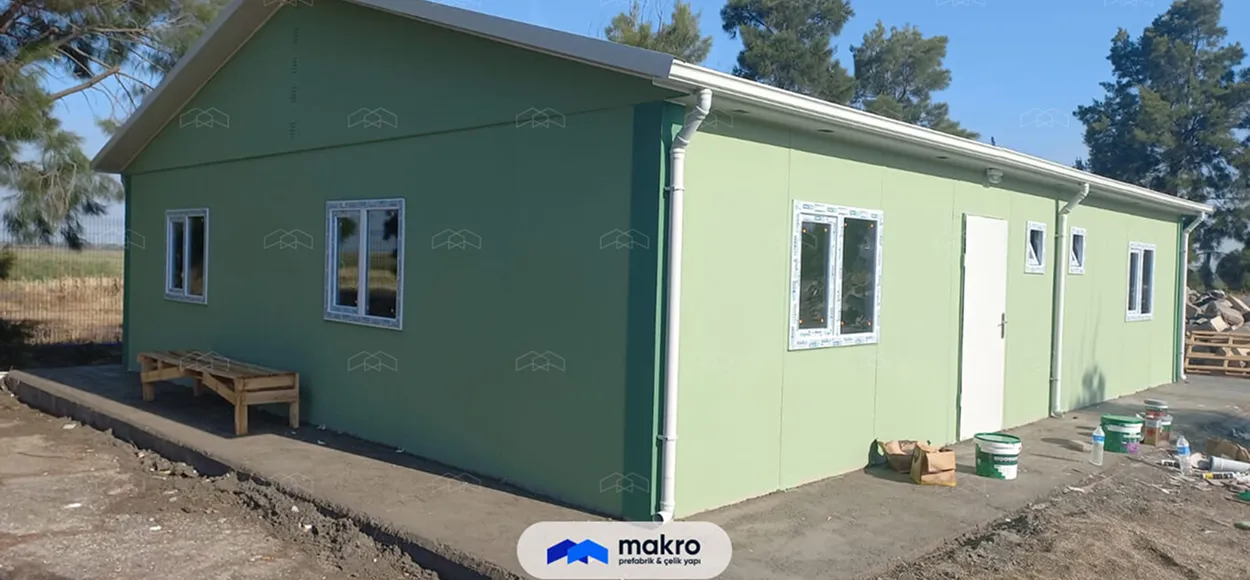
Turnkey prefabricated houses have all interior and exterior works completed in the factory with pre-produced panels, making them ready for use. One of the most important features of prefabricated structures is that they can be delivered much faster than traditional constructions; they become habitable within an average of 2-3 months.
Structural features of turnkey prefabricated houses include high thermal and sound insulation performance. Thanks to steel load-bearing systems, they are earthquake-resistant and durable. They are also highly economical in terms of energy efficiency, providing long-term cost advantages to users.
Another important feature of the houses is that they are modular and can be expanded. Additional rooms or floors can be easily added if needed. Using environmentally friendly materials, being recyclable, and generating minimal construction waste are also significant sustainability advantages. All electrical, water, and natural gas installations are pre-planned and delivered as part of the package.
Although the concepts of prefabricated house and steel house are often confused in the modern construction sector, there are important technical and structural differences. Prefabricated houses are structures built by assembling modular parts produced in a factory environment on a construction site. Various materials such as wood, lightweight steel, or concrete can be used. Steel houses, on the other hand, are structures based specifically on a steel frame system with a load-bearing skeleton made entirely of steel.
In terms of durability, steel houses stand out with high strength values and earthquake resistance, while prefabricated houses show variable durability depending on the materials used. The construction time for both systems is shorter than traditional buildings, but prefabricated systems generally offer faster assembly options.
From a cost perspective, prefabricated houses usually offer more economical options, while steel houses provide long-term durability and require minimal maintenance, thus offering investment value. Regarding design flexibility, steel frame systems allow for large spans and open plan arrangements, whereas prefabricated systems are limited to certain standards due to their modular nature.
When purchasing a turnkey prefabricated house, you should consider the following criteria for a successful buying process. First, thoroughly review the company's reference projects to evaluate their past experience and customer satisfaction. The production facility and quality standards, which directly affect the durability of your house, must be inspected in person. The choice of building system (panel/steel) should be determined according to your regional climate conditions and budget.
In technical features, insulation thickness and energy class are critical for your long-term energy savings. The absence of compliance documents with earthquake regulations is indispensable for your safety. The scope of warranty and after-sales support services, as well as the delivery time commitment, should be clearly stated in the contract.
For users considering long-term investment, a comprehensive approach should be adopted when evaluating prefabricated house prices and steel house prices. When making comparisons, not only the initial cost but also durability, maintenance, and lifespan should be considered. This way, you can perform a true cost-benefit analysis and make the most accurate investment decision.
The costs of turnkey prefabricated houses offered by Makro Prefabrik vary depending on factors such as the size of the project, the quality of materials used, and design features. These systems, which are 30-40% more economical compared to traditional construction methods, provide significant savings in the long term thanks to short assembly times and energy efficiency. With the professional approach of experienced teams, transparent pricing and comprehensive services are offered to customers.