
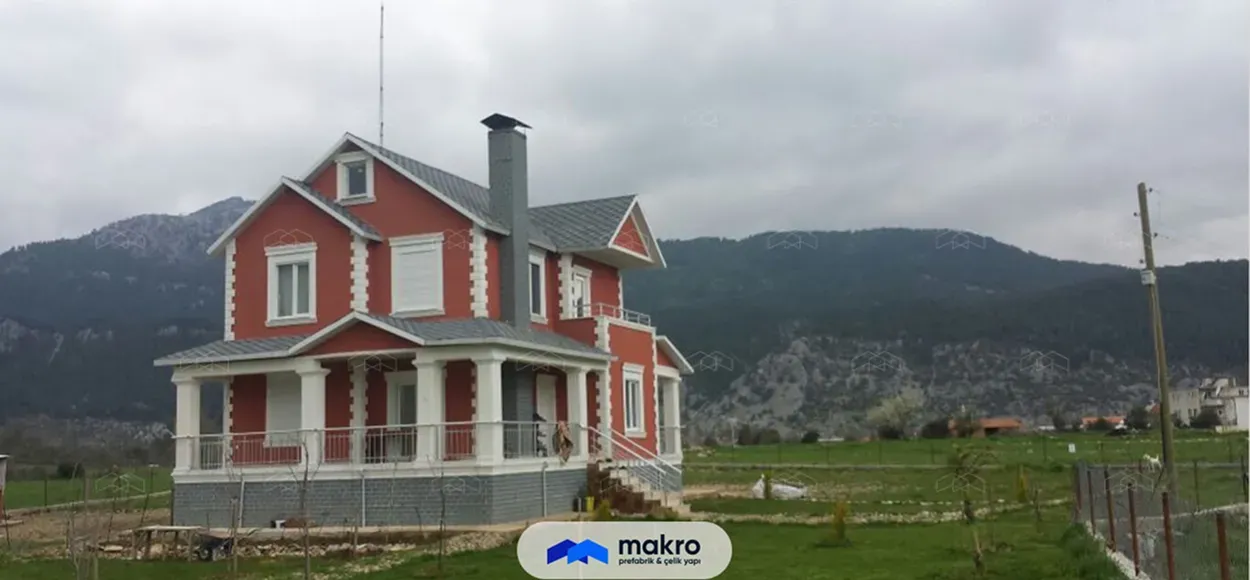
Rising land costs, lengthy traditional construction processes, and labor expenses have led investors to adopt faster and more controlled production techniques. At this point, steel and prefabricated systems have become a strong alternative for individual users and commercial projects. Due to fluctuations in material prices, currency effects, and advancements in manufacturing technologies in 2026, the most critical issue in housing planning is to accurately calculate the square meter area and create a realistic budget.
Many people focus on the total budget but overlook that the main determinant is the unit square meter cost. However, when calculations are not accurate, additional expenses may arise during the project, delivery times can be extended, and the return on investment may take longer than expected.
Steel house prices are calculated similarly to standard practices in the construction industry. In modern building systems, pricing is usually based on the gross square meter. What does this mean?
The gross area includes the total enclosed space, including interior walls, exterior wall thicknesses, and shared areas. For example, a project with a net living area of 100 m² may have a gross area of 110–115 m², and the offer is prepared based on this measurement. Therefore, users should focus not only on room sizes but also on the total enclosed area of the project.
When determining the square meter price, many items such as the skeleton system, roof covering, facade panel, thermal and sound insulation, electrical–plumbing installations, flooring, and kitchen–bathroom fixtures are added to the cost individually. The quality and features of each component directly affect the total cost. The reason for significant price differences between two houses of the same size is precisely these technical details. Therefore, instead of just looking at the price per square meter, it is extremely important to carefully examine what materials and services are included in this price. To make the right choice suitable for your project needs, you should compare offers where each item is clearly specified.
Wall panels and modular components prepared in the factory are assembled on-site in a short time and become ready for occupancy within weeks. Users who prefer these systems can clarify their budget plans by reviewing the prefabricated house prices based on average costs before starting the project. This is especially advantageous for single-story summer houses, farmhouses, or residential projects in rural areas. Prefabricated structures reduce the ground load due to their lightweight nature and lower foundation costs. However, the chosen panel thickness, roof insulation, and interior fittings directly affect the price. Therefore, instead of just looking at the initial figure, it is necessary to examine the technical specifications in detail. When the right combination is selected, prefabricated house prices can offer significant savings compared to traditional construction.
Progressing with a realistic example will help better understand the costs. Let's consider a house with a gross area of 120 m². When using mid-segment materials, the determined price per square meter is multiplied by all building components to reveal the total turnkey cost. This calculation should consider not only the structure itself but also many additional factors.
However, external costs such as land arrangement, soil survey, transportation, assembly team, municipal permits, and infrastructure connections are also added. These additional expenses can constitute a significant part of the total cost and directly impact the project budget.
Users often overlook these items, leading to budget discrepancies. Working with professional companies ensures that all details are clearly specified in the offer. This prevents surprises in costs and allows for transparent management of the project from the start.
Many buyers ask, “Should I get a turnkey project, or just a rough structure?” A rough structure initially appears more economical; however, when installations, flooring, kitchen, bathroom, and painting are added later, the total cost often approaches the turnkey option. Working with different craftsmen can cause time delays and quality inconsistencies. Therefore, comprehensive packages obtained from a single firm are more advantageous in terms of time and budget control.
Another important aspect besides price is the reliability of the manufacturer. Companies that produce according to technical standards and offer warranty and after-sales support should be preferred. Makro Prefabrik and other experienced producers in the sector make the investment process safer with transparent pricing policies and clear technical specifications. Working with a corporate firm eliminates many risks related to delivery time and quality.
The most correct approach when investing in housing in 2026 is to determine the appropriate size based on needs and perform a realistic analysis based on square meters. Due to rising construction costs and changing market conditions, accurately calculating the value of each square meter has become a key profit strategy. Instead of unnecessary large spaces, functional and needs-specific designed homes will reduce initial investment costs and save on maintenance and operating expenses in the long run.
Instead of focusing solely on the initial price tag, the overall building quality, energy efficiency, durability, and total operating costs should be evaluated together. A seemingly cheap house with poor insulation and low-quality materials can lead to significant increases in annual energy bills. Homes built with high-quality materials in accordance with modern construction standards, although initially more expensive, offer substantial savings over time.
With proper planning, you can protect your budget and own a modern living space that you can use trouble-free for many years. For users who act with this awareness, steel and prefabricated systems continue to be the most powerful options for fast and economical housing solutions.